
The popular misconception
Modern philosophy increasingly trains people to think ideologically.
Ideology (noun): a system of ideas and ideals, especially one which forms the basis of economic or political theory and policy.
Words like postmodernism, marxism, scientism, utilitarianism, fascism, liberalism, and almost anything ending in -ism, are thrown around carelessly. They are praised, defended, and often become part of people’s identities.
But why do we even have them in the first place? To answer this, I must explain how ideologies are formed.
The forming of an ideology almost always follows the same pattern:
- A particular true insight is discovered;
- That insight is treated as absolute;
- All of reality is forced to fit that main idea.
This is why ideologies are powerful. They simplify the world into something easy to grasp. A world explained by one set of ideas is easy to understand. But, their strength, simplicity, is also their weakness. Ideology prefers easy-to-grasp explanations over broad understanding.
In trying to give structure to reality within one set of ideas, they’re already making a fatal mistake.
Why? Reality isn’t simple. Reality is layered, complex, and often uncomfortable (and in a sense, impossible) to confront fully.
And don’t get me wrong, ideologies can be very useful in trying to understand the world, my key claim is just that you’ll never reach completion within one. Because reality can never be simple enough to fit in one single set of coherent ideas.
This also means that my intention is not to attack any singular ideology, but to attack the idea of making ideologies and adhering to them.
Clarifying with the help of G. K. Chesterton
G. K. Chesterton describes the flaw within forming ideologies neatly in Orthodoxy. His diagnosis of ideological madness applies directly to the way they’re made today:
“The madman is not the man who has lost his reason, the madman is the man who has lost everything except his reason.”
Here Chesterton is not claiming that everyone who is slightly inclined to adhere to some train of thought is immediately a total madman, but that the enterprise of going about life trying to make sense of the whole world with only logic and reason is destined to fail.
Chesterton explains further that ideologies form a logically perfect circle: every objection is answered, every contradiction is explained away, and every doubt is interpreted as ignorance or a desire to harm. And yet the circle is small, and doesn’t contain wider truth.
The smaller circle isn’t false in the common sense of the word, but it’s incomplete, which is another form of ‘false’ when trying to get to full understanding.
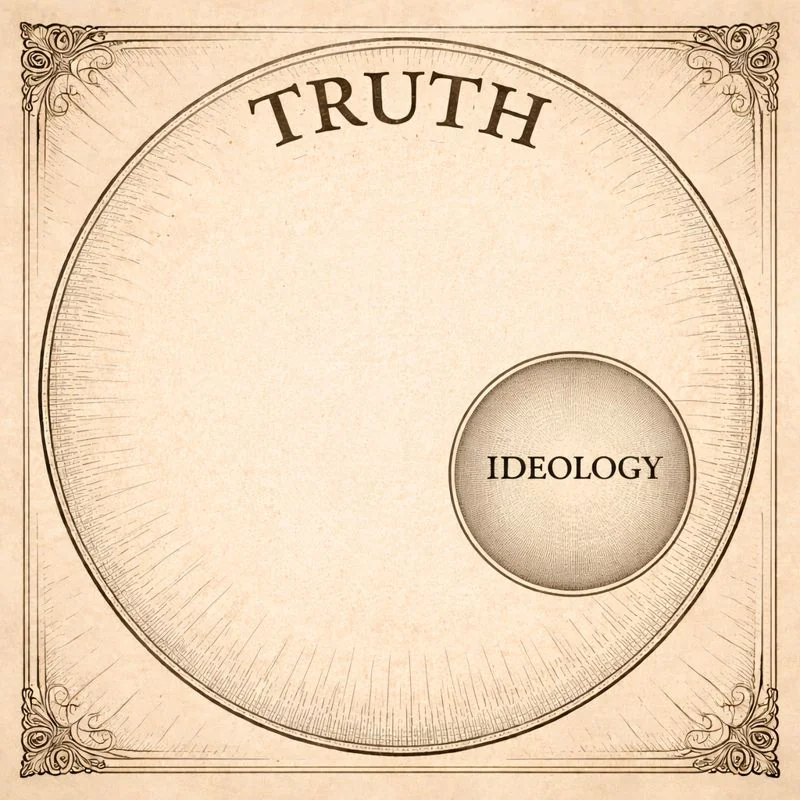
He continues: “His mind (the one who adheres to ideology) moves in a perfect but narrow circle.” Within certain ideologies, you can make actual sense of everything. Truly. Some ideologies can’t be taken down with logic. But true understanding of life and full truth requires expansion.
This is the heart of ideology: logical completeness without true correspondence to reality. It’s the same as math. You create a fictional world where everything fits perfectly like lego, but you always need a margin of error or a level of tolerance when trying to convert to reality.
Chesterton contrasts this with Christianity, which he holds to contain more complete truth:
“Christianity got over the difficulty of combining furious opposites, by keeping them both, and keeping them furious.”
Within the truth, you’re going to find concepts which seem to maybe contradict each other, or in any case not go well together, but in reality they need each other.
Take these two examples:
Limits give freedom: a child feels most free when playing inside a fenced playground, because the boundary creates safety and confidence, whereas total openness produces fear and paralysis. What seems like restriction is actually the condition for freedom.
Justice and mercy need each other, while this doesn’t seem to be the case at first glance. Justice insists that actions have strong consequences, while mercy insists that a person is more than their worst action. In practice, these demands often clash, which is why we instinctively lean toward one and neglect the other. But Justice and mercy need each other: justice without mercy becomes cruelty, but mercy without justice dissolves moral seriousness all together. By holding both together, moral depth is preserved instead of flattening it into a single principle.
These concepts don’t seem to go together within pure reason, but in reality, they have to go together. That why, on paper, it can feel painful to not draw clear conclusions that resolve this tension. But truth is not fragile because of it’s seemingly inner tensions. It stands in spite of them.
A deepened understanding on why we make ideologies
Human life on its own is often already filled with a lot of chaos. This doesn’t get any better when you start the adventure of making sense of the world. This is why we want mental structures to hold onto. They make the world feel safer.
But when the search for meaning loses humility and responsibility, it turns into easy ideology. Ideology offers understandable answers, order, and explanation without deeper understanding.
Ideology is not born from too much thinking, too little thinking, nor bad thinking, but from fear of the huge complexity that awaits you when you leave the comfort of narrow-placed thought.
Example: Postmodernism
Postmodernism starts with a real insight. It notices that power affects what gets called “truth”, that institutions are not neutral, and that language shapes how we see the world. All of that is true. The problem starts when this becomes the only explanation.
Postmodernism slowly turns everything into a story about power. Society is divided into people with power (bad, powerful men) and people without power (the victims of the powerful). In the long run, knowledge is no longer judged by whether it’s true, but by who benefits from it. Knowledge becomes domination, and moral authority and superiority comes from being a victim of oppression from power.
At that point, it becomes a closed system. Everything is explained by and looked at through the lens of power.
Where this misses something in reality: Power itself is morally neutral, which means injustice cannot be defined simply by who has power, but by how power is used and according to what standard.
When reality is reduced to power alone, responsibility fades and guilt is assigned by group identity rather than individual action. The result is not justice, but moral accounting, and a system that condemns oppression while lacking the moral ground to explain why oppression is wrong.
Again, notice that it all works on paper, but fails when it’s confronted with reality.
This is Chesterton’s “small circle”. Postmodernism explains some things well, but in reality, it leaves out responsibility, repentance, sacrifice, and broader truth itself. The circle is neat, but too small.
What now?
If ideologies often shrink reality to fit the understanding of our minds, what would be a better way of thinking to avoid such mistakes?
Let’s look at the best book ever made: The Bible. The Bible gives a clear answer, if you know where to look. But the answer is of a different nature than what is to be expected.
Because it doesn’t answer with an alternative thought-bubble, but rather with a posture or a stance.
“The fear of the Lord is the beginning of knowledge, but fools despise wisdom and instruction.” (Proverbs 1:7)
Fear of God (the Truth holder) here means: deep respect for the higher (God), recognition of our human limits, and submission to reality as God created it.
This leads to you never stopping and coming to a “finished” theory. This stance develops a healthy submission and acknowledgement of never being able to fit the entirety of truth into a small box.
“Trust in the Lord with all your heart, and do not lean on your own understanding.” (Proverbs 3:5)
This is not anti-reason. It is anti-reduction. Christianity does not explain everything right away. It explains everything within a stance towards God. Or if you’re a devout atheist, a higher idea / a truth that can never be (completely) contained. That is why it does not produce smaller circles.
Chesterton reaffirms this with this beautiful phrase: “A religion that is small enough for our understanding is not a religion big enough for our needs.”
Christianity, and the truth it contains, survive critique precisely because they: include paradox and preserve mystery, without trying to resolve these. Christianity demands a posture of humility towards truth.
Ideology says: understand and control. Christianity says: repent and see.
In short
A truthful intellectual posture looks like this:
- Be suspicious of systems or ideologies that explain everything.
- Prefer long-term wisdom over quick cleverness.
- Read widely, kneel before wider truth when you find it.
- Let Scripture judge your ideas, not serve them.